Methodology
How we turn real innovations into trends you can act on.
Three forces behind every trend
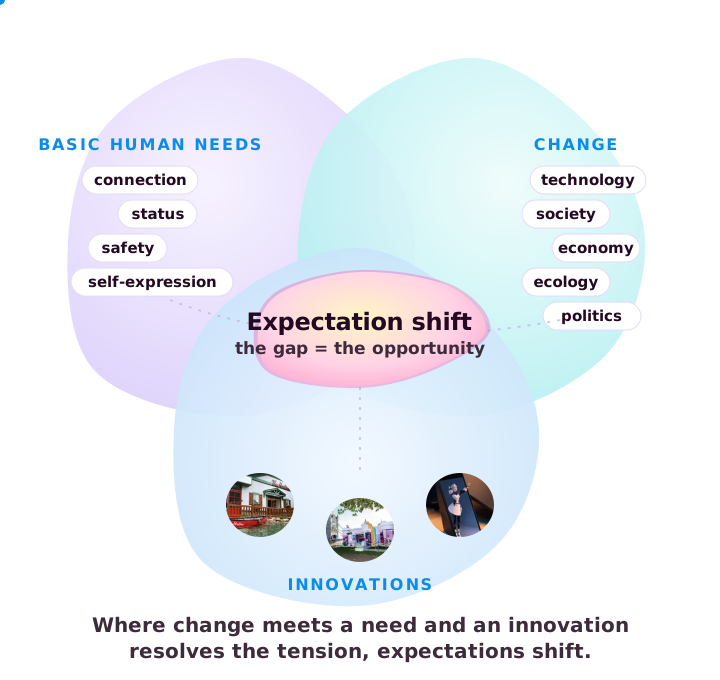
Every trend sits where three forces meet:
- Basic human needs. Fundamental, rarely changing needs and desires: connection, status, safety, self-expression.
- Change. Shifts in technology, society, economy, ecology and politics that alter what’s possible and what feels normal.
- Innovations. The products, services, experiences and campaigns that respond, and in doing so reset what customers expect.
Where change meets a need, tension builds. When an innovation resolves that tension, customers adjust what they expect, everywhere. We call that an expectation shift, and it’s what we track.
The space between that new expectation and what most brands still offer is the expectation gap. That’s where opportunities live.
The expectation economy
Every great innovation quietly raises the bar. Once customers experience something better, anywhere, it becomes the new normal they hold every brand to. That’s the expectation economy: customers compare you with the best experience they’ve had, in any industry, in any country.
Three routes expectations travel
- Across industries. What an app does for a taxi ride, customers soon expect from their insurer, their bank or their hotel.
- Across borders. Increasingly from Asia, Latin America and Africa outwards: super-app convenience from Grab, mobile money from M-Pesa, branchless banking from Nubank.
- Across generations. What feels normal to 20-year-olds today becomes the default for everyone soon after.
Transfer is never automatic, though. Access, economics, infrastructure and culture decide whether an expectation lands in a new market.
The next reset
AI lets brands launch, copy and improve in weeks, so the bar now moves almost continuously. Customers are starting to expect the task done for them: GOL in Brazil lets passengers check in and get their boarding pass inside ChatGPT, and Kia’s car-share vans in South Korea come to you by remote control. Early signals, worth watching closely.
The richest briefs sit in the tensions: personalisation and privacy, convenience and control, automation and the human touch. Customers want both sides, and the brands that resolve the tension set the next bar.
The gap is the opportunity
An opportunity is the gap between what customers are starting to expect and what they get today. We treat it as a hypothesis to test, backed by real innovations, never as guaranteed demand.
Six questions we ask about every shift
- 01What human need is involved?
- 02What’s changing?
- 03What new expectation might emerge?
- 04Where might it travel?
- 05Where is the gap in your market?
- 06What could you create in response?
The Trend Opportunity Framework
Our Trend Opportunity Framework turns innovations into opportunities, and keeps updating as new innovations come in.
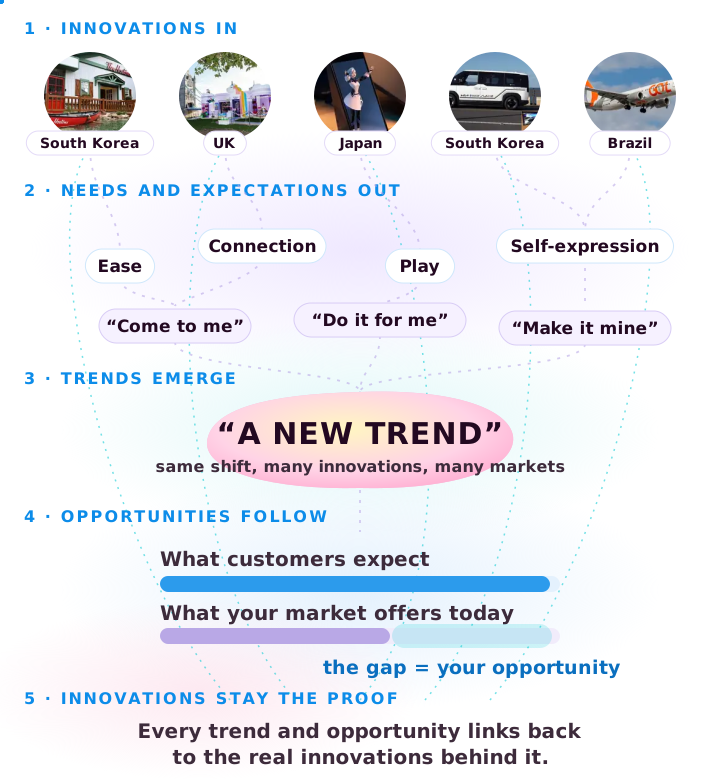
- Innovations in. Every new innovation enters with its date, country, industry and source.
- Needs and expectations out. For each one, we extract the human need it serves and the expectation it raises.
- Trends emerge. When the same expectation shift shows up across innovations, industries and markets, it becomes a consumer trend, named in CAPS, the TrendWatching way.
- Opportunities follow. Each trend points to gaps: where customers are starting to expect more than your market offers.
- Innovations stay the proof. Every trend and opportunity links back to the real innovations behind it, so you can check the evidence yourself.
Explore it on the platform, or bring it into ChatGPT, Claude, Mistral and others through ‘Your AI’.
From signal to opportunity
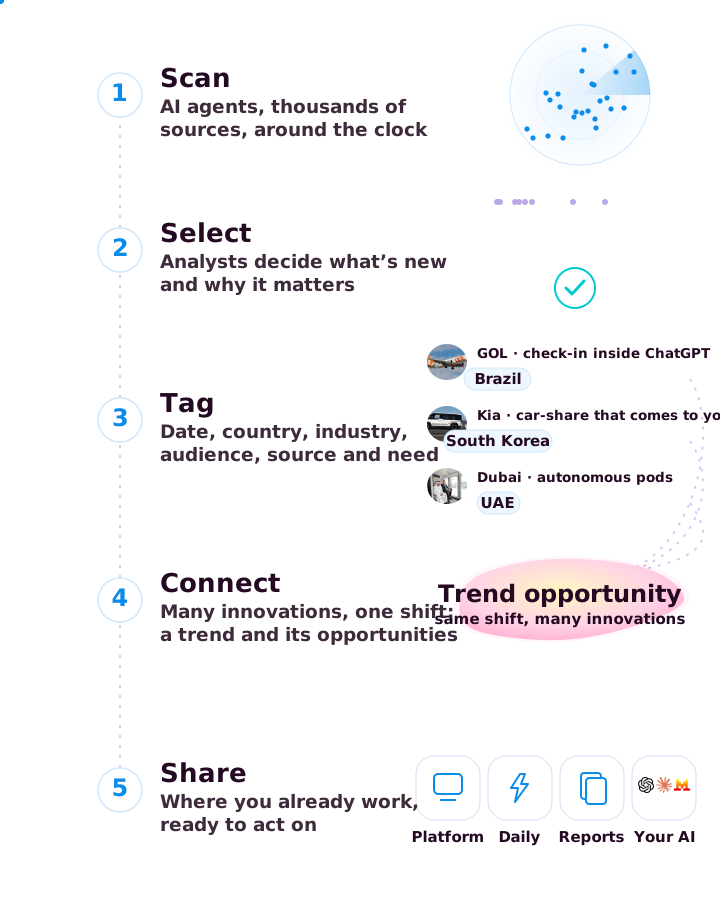
Scan. Our AI agents scan thousands of business sources around the clock, worldwide.
Select. Our analysts decide what’s genuinely new, why it matters and for whom. Machines for reach, people for judgement.
Tag. Every innovation gets its date, country, industry, audience and source, plus the human need and the expectation behind it.
Connect. The Trend Opportunity Framework links it to the trends and opportunities it proves.
Share. You get it where you work: on the platform, in the Daily, in our reports, and in your own AI through ‘Your AI’, with ready-made plays to put it to work.
AI makes it faster than ever to launch, copy and scale ideas, so expectations shift faster too. That’s why we never stop scanning.
See What’s Next. Create It First.